
I was studying The Church of the East on Wikipedia this morning and came across a portrait of Jesus Christ. I noticed his hand was raised in a gesture with the fore-finger highest, middle finger slightly lower and the ring and pinkie fingers held against the palm by the thumb.
I wondered if the artist had a purpose and the gesture was significant. I have heard that it was a sign of "Peace" but in my jumping from one wikipedia site to another, I found a few interesting things. I'll just randomly enter what I found.
Benediction and blessing. The benediction gesture is a raised right hand with the ring and little finger fingers touching the palm, while the middle and index fingers remain raised. Taken from Ancient Roman iconography for speaking and often called the benediction gesture, is used by the Christian clergy to perform blessings with the sign of the cross; however Christians keep the thumb raised — the three raised fingers (index, middle, and thumb) are frequently allegorically interpreted as representing the three Persons of the Holy Trinity.
NEXT, I saw the:
Bellamy salute was used in conjunction with the American Pledge of Allegiance prior to World War II. So of course I had to check out that link.

The Bellamy salute is the hand gesture described by Francis Bellamy (1855-1931) to accompany the American Pledge of Allegiance, which he had authored. During the period when it was used with the Pledge of Allegiance, it was sometimes known as the "flag salute". It was first demonstrated on October 12, 1892 according to Bellamy's published instructions for the "National School Celebration of Columbus Day":
At a signal from the Principal the pupils, in ordered ranks, hands to the side, face the Flag. Another signal is given; every pupil gives the flag the military salute -- right hand lifted, palm downward, to a line with the forehead and close to it. Standing thus, all repeat together, slowly, “I pledge allegiance to my Flag and the Republic for which it stands; one Nation indivisible, with Liberty and Justice for all.” At the words, “to my Flag,” the right hand is extended gracefully, palm upward, toward the Flag, and remains in this gesture till the end of the affirmation; whereupon all hands immediately drop to the side.
The inventor of the saluting gesture was James B. Upham, junior partner and editor of the The Youth's Companion.[1] Bellamy recalled Upham, upon reading the pledge, came into the posture of the salute, snapped his heels together, and said "Now up there is the flag; I come to salute; as I say 'I pledge allegiance to my flag,' I stretch out my right hand and keep it raised while I say the stirring words that follow."[1]
The initial civilian salute was replaced with a hand-on-heart gesture, followed by the extension of the arm as described by Bellamy.
In the 1920s, Italian fascists adopted the Roman salute to symbolise their claim to have revitalised Italy on the model of ancient Rome. This was quickly copied by the German Nazis, creating the Nazi salute. The similarity to the Bellamy salute led to confusion, especially during World War II. From 1939 until the attack on Pearl Harbor, detractors of Americans who argued against intervention in World War II produced propaganda using the salute to lessen those Americans' reputations. Among the anti-interventionist Americans was aviation pioneer Charles Lindbergh. Supporters of Lindbergh's views would claim that Lindbergh did not support Adolf Hitler, and that pictures of him appearing to do the Nazi salute were actually pictures of him using the Bellamy salute. In his Pulitzer prize winning biography Lindbergh, author A. Scott Berg explains that interventionist propagandists would photograph Lindbergh and other isolationists using this salute from an angle that left out the American flag, so it would be indistinguishable from the Hitler salute to observers.
In order to prevent further confusion or controversy, President Franklin D. Roosevelt instituted the hand-over-the-heart gesture as the salute to be rendered by civilians during the Pledge of Allegiance and the national anthem in the United States, instead of the Bellamy salute.[2] This was done when Congress officially amended the Flag Code on 22 December 1942.[3][4]
That brings us to another Salute :)
The Vulcan salute first appeared in 1967 on the Star Trek second season opening episode, "Amok Time".
In his autobiography I Am Not Spock, Nimoy wrote that he based it on the Priestly Blessing performed by Jewish Kohanim with both hands, thumb to thumb in this same position, representing the Hebrew letter Shin (ש), which has three upward strokes similar to the position of the thumb and fingers in the salute. The letter Shin here stands for Shaddai, meaning "Almighty (God)". Nimoy wrote that when he was a child, his grandfather took him to an Orthodox synagogue. There he saw the blessing performed and was very impressed by it.[1]
The accompanying spoken blessing, "Live long and prosper" (Dif-tor heh smusma in Vulcan language as spoken in Star Trek: The Motion Picture) also appeared for the first time in "Amok Time", scripted by Theodore Sturgeon.[2] The less-known reply is "Peace and long life." This format is similar to common Middle Eastern greetings (Shalom aleichem in Hebrew and Salaam alaykum in Arabic), meaning "peace be upon you", and its reply, "upon you be peace". Egyptology specialists have found that the Ancient Egyptians used a phrase which, when translated, is an almost perfect representation the phrase, read as "May he live long, prosper, and be in health."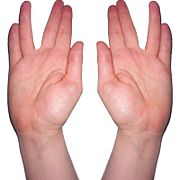 Blessing gesture that was the inspiration for the Vulcan salute.
So THAT's what I LEARNED today!!!!


No comments:
Post a Comment